
Language: From the Origins of Symbolic Thought to the Artificial Intelligence Revolution
Language is one of the most defining faculties of human experience. It enables us to name objects, describe events, formulate hypotheses, transmit knowledge, express emotions and coordinate collective action. Through language, an individual experience can become a shared narrative, an observation can be transformed into a theory, and an abstract idea can be passed on to generations who have never met its author.
Long studied primarily by linguistics, philosophy and psychology, language is now at the heart of a major technological transformation. Artificial intelligence systems capable of processing, analysing and generating text on a large scale are changing the conditions of communication, documentary research, intellectual creation and access to knowledge. Large language models (LLMs) can write articles, translate documents, summarise scientific publications, answer questions and interact with users in many languages.
This development raises a fundamental question: what exactly is language, and what does it mean for a machine to be capable of producing utterances that resemble those of a human being?
Answering this question requires distinguishing between several levels of analysis. Language is simultaneously a system of signs, a cognitive faculty, a social practice, a means of representing the world and a form of action. In computing, the term also refers to formal systems whose rules make it possible to write instructions that a machine can execute. These different meanings are closely related, but they are not interchangeable.
Understanding language therefore requires examining its biological and psychological foundations, its acquisition during childhood, its relationship with thought, its linguistic organisation, its social functions and its applications in computing. This approach also makes it possible to assess what artificial intelligence systems actually accomplish, without confusing the production of coherent discourse with demonstrated possession of consciousness, intention or human understanding.
1. What Is Language? Definition and Main Characteristics
Language can be defined as the capacity to use organised signs to represent information, construct meaning and communicate in specific situations. This definition encompasses natural languages, such as French, English and Arabic, as well as certain formal systems used in mathematics, logic and computing.
It is nevertheless important to distinguish between three fundamental concepts: language as a general faculty, a particular language as a shared system, and speech as an individual act of expression.
Language: A General Faculty of Representation and Communication
Language refers to the general capacity to organise and interpret signs. In human beings, this faculty relies on cognitive, perceptual, motor and social mechanisms that enable them to associate forms with meanings and produce utterances suited to a wide range of situations.
This capacity is not limited to producing sounds. It plays a role in comprehension, memory, categorisation, anticipation and the construction of mental representations. It can also be expressed through writing, manual signs or augmentative and alternative communication systems.
Human language has a remarkable capacity for recombination. From a limited number of sounds, words and rules, it becomes possible to produce an enormous variety of new utterances. A person can describe a past event, imagine a situation that does not exist, explain a scientific theory or consider the consequences of a future decision.
This productivity is one of the central properties of language: the possibilities of expression extend far beyond the number of sentences actually memorised.
A Particular Language: A Shared System of Signs and Rules
A language is a conventional system shared by a community. It includes vocabulary, grammatical structures, rules of combination, social practices and conventions that make communication possible.
English, for example, associates spoken or written forms with meanings and organises relationships between words through morphological and syntactic rules.
A language is not merely an inventory of terms. Meaning also depends on word order, context, relationships with other expressions and the knowledge brought into play by the people communicating.
The difference between “the dog chases the cat” and “the cat chases the dog” illustrates the role of syntax: the same words can describe different situations when their arrangement changes.
A language is also a historical reality. Its vocabulary evolves, its uses change, and its norms vary according to social groups, regions, generations and communicative situations.
Speech: The Individual Actualisation of Language
Speech corresponds to the concrete realisation of language in an act of communication. It involves vocal production, articulation, intonation, rhythm, pauses and lexical choices.
The same sentence can have different effects depending on how it is spoken. Intonation can express doubt, irony, anger or enthusiasm without changing the words themselves.
In writing, some of this information is conveyed through punctuation, formatting, register and context. Digital communication introduces additional cues, such as emoticons, images, reactions and conventions specific to individual platforms.
Speech is therefore not simply the mechanical execution of a language. It is a situated activity shaped by intentions, emotions, constraints and relationships between participants.
Human Language, Animal Communication and Artificial Systems
Communication is not exclusive to humans. Many animal species use auditory, visual, chemical or gestural signals to indicate danger, attract a mate, defend territory or coordinate behaviour.
Some species display remarkable abilities to learn, discriminate between sounds, associate signals with situations or communicate through gestures. Research on primates, songbirds, cetaceans and other animals has considerably expanded our understanding of communication mechanisms.
It would therefore be reductive to contrast animal communication as entirely reflexive with human language as exclusively rational. Differences must be examined property by property: referential capacity, learning, signal combination, cultural transmission, displacement in time and space, productivity and intentional use.
Human languages are distinguished, among other things, by the breadth of their combinatorial possibilities, their capacity to address subjects absent from the immediate situation, and their integration into complex systems of culture, institutions and knowledge transmission.
Artificial systems introduce a different category. They can manipulate signs, learn regularities and generate linguistic sequences, but their operation depends on computer architectures, data and specific training procedures. The resemblance between their outputs and human discourse is not, by itself, sufficient to establish equivalence between their mechanisms and those of human cognition.
2. Symbolic Function: Representing What Is Not Present
One of the most important properties of language is its ability to make something materially absent present through representation.
The word “mountain” can evoke a landscape without any mountain being visible. The term “tomorrow” makes it possible to discuss a future event. An expression such as “social justice” refers to an abstract concept that cannot be reduced to any particular object.
This ability relies on symbolic function: the capacity to establish a relationship between a perceptible form and a representation, an object, an action, a situation or a concept.
From the Perceived World to the Represented World
The psychologist Henri Wallon gave symbolic function an important place in his account of child development. From this perspective, a symbol makes it possible to separate an object from its immediate presence and represent it through another element.
This operation profoundly expands the possibilities of mental activity. An experience occurring in the present can be recalled later; an action can be anticipated; one object can stand for another in play; and a real situation can be transformed into a narrative.
A symbol is therefore not identical to the object it represents. It establishes a relationship of substitution that makes recollection, comparison and mental manipulation possible.
When a child pretends to feed a doll using an object that represents a spoon, the activity goes beyond physical manipulation. The object acquires a new function within an imaginary scenario. The game thus demonstrates an ability to distinguish immediate reality from the meaning attributed to things.
Language develops this possibility on an enormous scale. It allows us to represent not only objects, but also relationships, intentions, rules, categories and complex events.
Signal, Index, Symbol and Sign: Essential Distinctions
Not every element that conveys information operates in the same way.
A signal can trigger a response in a particular context. A siren warns of danger; a bell announces a change of situation. An index generally has a relationship with what it allows us to infer: tracks on the ground may indicate that an animal has passed by.
A symbol relies on a representational relationship that may depend on convention, resemblance or shared usage. In a game, a box can represent a house. On a map, a graphic shape can indicate a city.
A linguistic sign, in turn, associates a form with content according to the conventions of a language. The word “tree” does not need to resemble the plant itself to be understood by people who know English.
These categories do not always form absolute boundaries. The same element can function as an index in one situation and as a symbol in another. Nevertheless, distinguishing between them is useful for understanding how information becomes a representation and how that representation can be interpreted.
The Arbitrariness and Conventions of the Linguistic Sign
In a language, the relationship between the form of a word and its meaning is generally conventional. Nothing in the sound sequence of the word “water” naturally requires that particular form rather than another.
French uses “eau”, Spanish uses “agua”, and German uses “Wasser”. These differences show that linguistic communities associate distinct forms with comparable realities.
The arbitrariness of the sign does not mean that all relationships between words and the world are arbitrary. Onomatopoeia, sound associations, metaphors and certain morphological regularities can establish more direct relationships with experience. Nevertheless, the general functioning of a language relies on collective conventions that cannot be changed unilaterally without compromising mutual understanding.
For artificial intelligence systems, this characteristic raises a central problem: learning the regularities of a language does not simply mean recognising sequences of characters. It also involves determining which relationships between these forms, situations and bodies of knowledge make it possible to produce a relevant interpretation.
3. The Origins of Language: Biological Evolution, Cooperation and Cultural Transmission
The origins of human language remain a complex research topic. No direct record allows us to reconstruct humanity’s first conversations, and linguistic abilities do not fossilise in the same way as bones or tools.
Scientists must therefore combine several types of evidence: anatomy, genetics, neuroscience, archaeology, the study of languages, comparisons with other species and analyses of the cognitive abilities required for communication.
An Evolutionary History That Remains Partly Unknown
Human language most likely emerged from a long evolutionary history rather than from a single isolated innovation. It depends on the coordination of several abilities: auditory or visual perception, motor control, memory, learning, categorisation, shared attention and social cognition.
The biological changes that made articulated speech possible are not, on their own, sufficient to explain the emergence of languages. The ability to produce sounds does not yet constitute a grammatical system, and the ability to learn associations does not explain the richness of human conversation.
The evolution of language must therefore be understood as a set of interdependent transformations. Anatomical changes, cognitive mechanisms, social interactions and systems of cultural transmission may have reinforced one another throughout human history.
The details of this evolution remain debated. There is no consensus that would allow the emergence of language to be attributed to a single cause or a precise date.
The Role of the Brain and Neural Networks
Language involves several brain regions and distributed networks. Certain frontal regions contribute to speech planning and various aspects of linguistic processing. Temporal regions participate in recognising sound patterns, accessing lexical information and understanding language. Parietal networks, connecting pathways and other brain systems contribute depending on the task.
This organisation does not correspond to a single centre in which all language is stored. Understanding a sentence, for example, involves perceptual, lexical, syntactic, semantic and contextual operations that interact rapidly.
Speech production also requires precise coordination between linguistic planning, word selection, phonological organisation, articulatory movements and sensory feedback.
Neuroscience research has also shown that the functional organisation of language varies between individuals, tasks and developmental trajectories. Certain functions are frequently lateralised, but linguistic processes cannot be reduced to a simple opposition between a left hemisphere responsible for language and a right hemisphere responsible for emotions.
Advances in brain imaging, electrophysiology and the clinical study of language disorders continue to refine our knowledge. They do not, however, justify the idea of a prefrontal “superbrain” that would explain symbolic function on its own. Language relies on interdependent brain systems embedded in an organism interacting with its environment.
Social Cooperation as a Possible Driving Force
Collective life provides an essential context for the emergence and development of language. Coordinated activities require people to transmit information, share attention, anticipate one another’s behaviour and preserve useful knowledge.
Toolmaking, the organisation of work, hunting, the transmission of techniques, childcare and exchanges within groups are all areas in which more sophisticated communication systems may offer advantages.
These hypotheses do not establish that any single activity caused language to emerge. Rather, they suggest that the pressures associated with cooperation and cultural transmission may have favoured increasingly flexible communication abilities.
Language makes a particular form of coordination possible: individuals can act not only in response to what they perceive, but also on the basis of instructions, narratives, rules and shared plans.
Culture Transforms a Biological Capacity into Linguistic Competence
A biological capacity does not, by itself, determine which language an individual will speak. Language acquisition depends heavily on interactions with an accessible linguistic environment.
A child exposed to French from the earliest years of life can gradually acquire its structures. A child growing up in an English-speaking environment normally develops English, provided that conditions are favourable to learning. Multilingual development demonstrates that human capacities also support the acquisition of several languages.
Biological maturation makes certain operations possible, but experience helps organise and refine them. Language learning therefore combines cognitive predispositions, social interactions, repeated exposure and learning mechanisms.
This relationship between biology and environment represents an important point of convergence between research on human development and research on machine learning. In both cases, observed abilities depend on internal mechanisms and the information to which a system is exposed. The similarities end, however, where architectures, learning methods and conditions of existence become fundamentally different.

4. How Language Emerges in Children
Language acquisition does not begin when a child speaks their first word. It develops along a trajectory that includes speech perception, emotional exchanges, vocalisations, shared attention, word comprehension and the gradual construction of utterances.
The stages of this trajectory display certain regularities, but their timing varies according to the child, the language, the environment and individual circumstances.
Early Interactions: Before Words
From the first months of life, exchanges between a child and the people around them rely on facial expressions, eye contact, movements, vocalisations and variations in the voice.
Crying initially responds to different physiological or emotional states. Adults gradually attribute possible meanings to these cries and adjust their responses accordingly. This coordination helps establish interaction routines.
Smiling, looking and vocalising also contribute to the organisation of exchanges. Children learn to distinguish certain patterns in the human voice, respond to intonation and orient themselves towards communicative events.
These behaviours do not yet constitute articulated language. Nevertheless, they form an important part of the context in which linguistic communication develops.
Babbling and Learning Sounds
During the first year, children’s vocalisations become more varied. Babbling includes repeated syllables and combinations of sounds that evolve alongside motor and perceptual development.
At the same time, children receive auditory information about their own productions and the speech of those around them. This experience gradually helps them adjust the sounds they produce and those they learn to recognise.
Babbling does not simply reproduce the sounds of the family language from the outset. It displays considerable variation before changing through linguistic exposure and the maturation of perceptual and articulatory abilities.
Responses from caregivers play an essential role. They give vocalisations a place in exchanges and allow children to explore the relationships between their own productions and other people’s reactions.
Comprehension Often Precedes Production
A child may recognise words or respond to instructions before being able to pronounce them clearly. Comprehension and production are related but distinct dimensions of linguistic competence.
To produce a word, a child must coordinate several operations: identify what they want to express, select a linguistic form, organise the sounds and perform the movements necessary to produce them.
Comprehension requires other operations, including pattern recognition, access to meaning and interpretation of context.
Differences between these two dimensions are therefore expected. They are not necessarily signs of difficulty.
First Words and the Construction of Meaning
First words generally appear during the second year of life, although there is considerable variation. A word may initially refer to an object, a person, an action, a desire or an entire situation.
A single expression can therefore function as a complete sentence within its context. The word “cake” might mean “here is the cake”, “I want some cake” or “give me the cake”, depending on the situation and the gestures accompanying it.
This condensed use of language demonstrates that meaning does not depend solely on the words spoken. It also results from context, presumed intentions, shared experience and non-verbal cues.
From Juxtaposition to Grammar
As linguistic development progresses, children gradually combine words and produce more complex utterances. Early combinations may be brief, before grammatical markers, pronouns, prepositions, verb tenses and subordinate clauses develop.
Children do not simply memorise ready-made sentences. They generalise patterns and sometimes produce new forms, including incorrect ones that reveal their provisional understanding of rules.
These errors provide useful evidence of learning. They show that children are constructing patterns and attempting to apply them to new cases.
Language development is not, however, limited to acquiring grammar. It also includes vocabulary expansion, adapting to different interlocutors, understanding narratives, explaining ideas and learning the social conventions of conversation.
Questions, Narratives and the Development of Abstract Thought
As their skills develop, children ask questions about objects, causes, places, intentions and time. These questions demonstrate an increasing ability to organise experience and seek relationships between events.
Questions such as “why?”, “how?” or “what would happen if…?” open up spaces for reasoning that go beyond immediate description.
Narrative also plays an important role. Telling an event requires selecting information, ordering it, establishing temporal relationships and making certain elements explicit for an interlocutor who did not experience the situation.
Reading and writing further enrich this ability. They make language observable, durable and open to analysis. An utterance can be reread, compared, corrected and examined independently of the situation in which it was produced.
These skills develop throughout childhood and adolescence, then continue to evolve through experience, education and cultural practices.
5. Language and Thought: Closely Related but Distinct Functions
The relationship between language and thought is one of the major problems in psychology and philosophy. Language makes it possible to formulate reasoning, but not every mental operation necessarily takes the form of a sentence.
Recognising a face, identifying a melody, coordinating a movement or constructing certain spatial representations may involve processes that cannot be reduced to verbal formulation.
Conversely, language provides powerful means of constructing categories, making relationships explicit and manipulating abstract concepts.
Language Organises Experience
Naming something makes it possible to identify it as a member of a category. The word “bird” groups a wide variety of organisms under a common designation. Terms such as “democracy”, “energy” and “probability” allow us to refer to concepts that cannot be accessed directly through a single act of perception.
Words make a form of conceptual compression possible: a single term can condense a set of properties, experiences and shared knowledge.
This compression does not guarantee that a person fully understands the concept. Someone may use the word “inflation” correctly in conversation without understanding the corresponding economic mechanisms. Knowing a linguistic label and mastering the underlying concept must therefore be distinguished.
Language facilitates conceptualisation, but it does not replace experience, observation, demonstration or in-depth learning.
The Perspectives of Piaget and Vygotsky
Jean Piaget studied the gradual construction of cognitive operations in children. His approach emphasises, among other things, the role of activity, the coordination of actions and the transformation of structures of thought.
Lev Vygotsky, for his part, assigned a central role to social interactions and language in the development of higher psychological functions. From this perspective, certain forms of language initially used in exchanges with others can gradually be internalised and contribute to the self-regulation of activity.
These approaches should not be presented as entirely opposing explanations. They emphasise different dimensions of development: cognitive construction, action, social mediation, cultural tools and internalisation.
Language can, in particular, be used to plan a task, recall an instruction, compare solutions or monitor an action. Someone who formulates the stages of a reasoning process is using linguistic resources to organise mental activity.
Inner Speech and Self-Regulation
Inner speech refers to forms of mental verbalisation that accompany certain activities. It can contribute to planning, memorisation, problem analysis and the preparation of a response.
However, it is neither constant nor identical across individuals. Some tasks rely more heavily on mental imagery, spatial representations, automatic processes or other forms of processing.
Inner speech therefore illustrates a functional relationship between words and thought without justifying an excessive conclusion: thinking does not always mean talking to oneself mentally, and the absence of conscious verbalisation does not mean the absence of cognition.
Do Words Influence How We Perceive the World?
Languages divide up experience according to different conventions. They vary in their systems of tense, aspect, grammatical gender, colour categorisation, spatial description and designation of social relationships.
These differences can direct attention, facilitate certain distinctions or make particular information more accessible in specific tasks.
Nevertheless, it is important to avoid absolute linguistic determinism, according to which a language would confine its speakers to a worldview they could never transcend. Human beings can learn other languages, translate concepts, invent expressions and acquire new categories.
The relationship between language and cognition is therefore more subtle than simple determination. Linguistic structures can influence certain information-processing habits without entirely fixing the possibilities of thought.
Language as a Tool for Collective Reasoning
Human thought also benefits from the accumulation of knowledge produced by other individuals. A scientific definition, a mathematical proof, a legal text or a technical method can be transmitted, criticised and improved over time.
Language makes it possible to preserve intellectual achievements beyond individual experience. It enables public discussion, the confrontation of hypotheses and the correction of errors.
Modern science depends heavily on this symbolic infrastructure: observations are described, methods documented, results compared and theories subjected to collective scrutiny.
Human intelligence therefore does not reside solely in the isolated capacities of a brain. It also depends on symbolic tools, institutions, archives and exchanges that make knowledge cumulative.
6. The Main Dimensions of Language: Phonology, Morphology, Syntax, Semantics and Pragmatics
A language functions through several levels of organisation that interact continuously. Distinguishing between them makes it possible to describe linguistic mechanisms and understand the difficulties encountered by computer systems.
Phonetics and Phonology: The Sound Structure of Language
Phonetics studies the physical and articulatory properties of speech sounds: movements of the vocal organs, acoustic transmission and auditory perception.
Phonology examines how a language organises sounds and the differences that make it possible to distinguish linguistic units.
Languages do not all use the same sound inventories, and the same sound may be perceived differently depending on listeners’ linguistic habits.
Automatic speech recognition must handle these variations, alongside accents, speaking rates, hesitations, background noise and differences between voices.
Morphology: How Words Are Constructed
Morphology studies the internal structure of words and the units that contribute to their form and meaning.
In English, “sing”, “singer”, “singing” and “unsingable” illustrate morphological relationships. Prefixes, suffixes and grammatical markers make it possible to form new words or express information such as number, person and tense.
This dimension is important for natural language processing systems. A model must be able to process forms it has not encountered in exactly the same appearance, drawing on morphological and contextual regularities.
Agglutinative, inflectional and isolating languages have different characteristics that influence methods of text segmentation and representation.
Syntax: Organising Relationships Between Words
Syntax describes the principles that govern the construction of word groups and sentences. It organises relationships between elements and helps determine who performs an action, what the action affects and under what circumstances it takes place.
Consider the following sentences:
- “The journalist interviews the researcher.”
- “The researcher interviews the journalist.”
The words are identical, but their arrangement changes the meaning of the utterance.
Syntax also helps resolve relationships between clauses and identify long-distance dependencies. In a complex sentence, a pronoun may refer to an element mentioned several words earlier, requiring information to be retained and made available during processing.
Formal grammars seek to describe explicitly the rules that generate or characterise linguistic structures. They have played an important role in theoretical linguistics and computer science, particularly in the design of programming languages and syntactic parsers.
Natural languages, however, contain variations, ellipses, informal constructions and ambiguities that make them more complex to describe than many computer languages.

Semantics: Constructing Meaning
Semantics studies the meanings of words, expressions and sentences, as well as the relationships that organise them.
A word may have several meanings. In English, “mouse” can refer to an animal or a computer device. The word “root” can belong to the vocabulary of botany, mathematics or linguistics.
Disambiguation often depends on context. In “the mouse disappeared behind the furniture”, the animal interpretation is plausible. In “the mouse no longer responds on the screen”, the computing context points towards a different meaning.
The meaning of a sentence also depends on how its components are combined. Identifying individual words is not enough: their relationships must also be taken into account.
Artificial intelligence models learn contextual regularities that often enable them to select an appropriate interpretation. However, they can fail when context is insufficient, contradictory or too far removed from their acquired knowledge.
Pragmatics: Understanding What We Do with Words
Pragmatics examines how meaning depends on the communication situation, intentions, shared knowledge and social conventions.
The sentence “It’s cold in here” may be a simple observation about the temperature, a complaint or an indirect request to close a window.
The linguistic form alone is therefore not always sufficient to determine the communicative action. Interpretation depends on the situation and the expectations associated with the exchange.
Pragmatics studies speech acts, implicatures, presuppositions, irony, indirect meanings and turn-taking in conversation.
This dimension represents a major challenge for artificial intelligence. A system can produce a grammatically correct sentence without fully understanding the social constraints or practical consequences of using it.
Discourse: Beyond the Isolated Sentence
Real exchanges rarely consist of independent sentences. They form discourses in which information is distributed, revisited and transformed over time.
To interpret a pronoun such as “she”, it is often necessary to identify its referent in a previous sentence. To understand a conclusion, it may be necessary to reconstruct the argument developed over several paragraphs.
Discourse coherence relies on relationships involving cause, contrast, sequence, explanation and reformulation. It also depends on the ability to distinguish new information from information that is already known.
Large language models can process extended contexts and maintain certain relationships between different parts of a document. However, their performance varies according to context length, dependency complexity, data quality and the nature of the task.
7. Language Ambiguity: A Central Challenge for Machines
Human language is remarkably effective despite its imprecision. Conversation works because participants draw on shared knowledge, correct their interpretations and adapt their wording to the context.
For a computer system, these ambiguities can make processing particularly difficult.
Lexical Ambiguity
A word can have several meanings. The term “bank”, for example, can refer to a financial institution or the side of a river. Context generally makes it possible to select the relevant interpretation.
Natural language processing systems must learn to associate lexical forms with the contexts in which their different meanings occur.
Syntactic Ambiguity
A sentence may allow several grammatical analyses.
In “The journalist observes the man with binoculars”, the phrase “with binoculars” may identify the instrument used by the journalist or, depending on the context, describe the man being observed.
Linguistic systems must determine which syntactic relationships are plausible and which interpretations fit the situation.
Implicit References
Languages frequently use pronouns, ellipses and expressions whose interpretation depends on earlier information.
“Marie spoke to Sophie after her interview” does not necessarily specify whose interview it was. Several interpretations are possible.
A system may suggest a plausible reading, but statistical plausibility is not proof that this reading corresponds to reality.
Irony and Implicit Meaning
“What a brilliant idea!” may express sincere approval or ironic criticism.
Interpretation depends on intonation, the situation, shared knowledge and the history of the relationship between the participants.
Text-only systems, which lack certain non-verbal cues, must infer these elements from partial evidence. Even multimodal models capable of processing sound or images do not automatically have access to all the social information required.
Why Does Ambiguity Matter for AI?
Statistical systems can learn that certain interpretations are more frequent than others. They can therefore resolve many everyday cases with a high degree of effectiveness.
However, rare situations, contradictory wording, complex references and misleading contexts remain problematic.
The ability to produce a plausible answer does not guarantee that a system has identified the only correct interpretation. This distinction is essential in fields where a misunderstanding can have legal, medical, financial or operational consequences.
8. Formal Languages: When Signs Follow Explicit Rules
The word “language” also refers, in mathematics and computing, to systems of symbols whose construction rules can be formally defined.
These languages have properties that differ from those of natural languages. They are generally designed to enable precise representation, systematic analysis or the execution of instructions.
The Principle of a Formal Language
A formal language can be described in terms of an alphabet, a set of rules and a set of permitted sequences.
If an alphabet contains the symbols 0 and 1, it is possible to define a language consisting only of sequences in which the number of 1 digits is even. The system then has precise rules for determining whether a sequence belongs to the language.
This approach does not depend on the presence of a human interlocutor. Whether a sequence belongs to the language can be established through a formal procedure.
Formal languages thus make it possible to distinguish the structural correctness of an expression from its interpretation.
Grammars and Production Rules
A formal grammar describes construction rules. For example, a rule might specify that a sentence consists of a noun phrase and a verb phrase.
In a simplified scheme:
Sentence -> NounPhrase VerbPhrase
NounPhrase -> Determiner Noun
VerbPhrase -> Verb NounPhrase
These rules make it possible to represent certain possible structures. They are not sufficient to describe all the subtleties of English, but they illustrate the principle of grammatical generation.
Grammars can vary in their expressive power. Some describe relatively simple patterns, while others represent more complex structural dependencies.
Research into formal grammars has contributed to the development of mathematical linguistics, compilers and automata theory.
Programming Languages
Python, C++, JavaScript, Rust and Julia are programming languages. They make it possible to describe operations that computer systems can interpret or execute according to defined rules.
A programme must comply with a specified syntax, but correctness goes beyond form. It must also produce the expected behaviour under the intended conditions.
A programme can be syntactically valid and nevertheless contain a logical error. It may also work on certain examples while failing in particular situations.
This distinction is important for understanding artificial intelligence systems: a well-formed instruction is not necessarily an appropriate instruction, and a technically valid result is not necessarily accurate or useful.
Natural Language and Computer Language
Natural languages emerge through collective use and evolve over time. Programming languages are specified through technical rules and execution environments.
This distinction does not prevent interaction between the two domains. Programmers use natural language to explain their intentions, while formal languages make it possible to translate certain operations into precise instructions.
Artificial intelligence models can now generate code from descriptions written in French or English. This capability brings programming interfaces closer to conversational practices, but it does not eliminate the need to test programmes, verify their dependencies and examine their consequences.
9. The Four Dimensions of Semiotics: From Signs to Action
Semiotics studies signs, their meanings and their uses. It provides a particularly useful framework for comparing human communication with computer systems.
Four dimensions can organise this analysis: the recognition of forms, syntax, semantics and pragmatics.
Recognising Units
Before interpreting a message, a system must identify its constituent units. For text, these may include characters, words, morphemes or segments defined by a particular segmentation procedure.
Speech processing involves, among other things, recognising acoustic patterns and associating them with linguistic units.
In modern language models, segmentation into tokens does not necessarily correspond to words as defined by grammar. A token may represent an entire word, part of a word, a punctuation mark or another technical unit.
Segmentation is an important step, but it is not enough to understand a message.
Analysing Structure
Syntactic analysis aims to determine how units are organised and what relationships they have with one another.
In traditional systems, it may produce a syntax tree or a set of dependency relations. Modern neural models also learn structural regularities without necessarily using an explicit traditional grammatical representation at every stage.
Results depend on the language, the type of text and the training data. Unusual constructions, errors and incomplete formulations can complicate the analysis.
Interpreting Meaning
Semantic analysis seeks to associate a representation with a linguistic expression. This representation may be logical, conceptual, statistical or related to a particular task.
In a computer application, an expression may be transformed into a query, command or data structure.
In a conversation, interpretation must also take account of polysemy, references and contextual knowledge.
The numerical representations used by neural models should not be confused with complete understanding of meaning. They are learned computational structures that enable many linguistic tasks, but their relationship with human understanding remains a subject of research.
Connecting a Message to Its Use and Consequences
Pragmatics examines how a message is used in a situation and how it can produce an effect.
In a computer system, this dimension may correspond to transforming a request into an action: searching for a document, calling a tool, modifying data or executing an operation.
Moving from text to action requires additional rules. A sentence can be understood without its execution being authorised, desirable or safe.
An assistant receiving the request “delete all unnecessary files” must identify the files concerned, assess the ambiguity of the instruction and respect the available permissions. Producing a technically valid command does not guarantee that the action matches the user’s intention.
The distinction between form, meaning, use and action is therefore essential to designing reliable artificial intelligence systems.
10. From Natural Language Processing to Large AI Models
Natural language processing (NLP) encompasses computer-based methods for analysing, transforming and generating linguistic data.
It is one of the most visible areas of contemporary artificial intelligence. It includes older techniques based on explicit rules, statistical methods and modern neural architectures.
Early Approaches: Rules, Dictionaries and Grammars
Early language-processing applications relied heavily on rules written by specialists. Systems could use dictionaries, grammars, lists of word forms and transformation procedures.
This approach made it possible to handle well-defined cases, particularly in controlled environments. However, it became difficult to maintain when formulations varied, ambiguities multiplied or languages displayed complex structures.
Machine translation illustrates this difficulty. Translating a sentence does not mean replacing each word with its equivalent in another language. It also requires taking syntax, idiomatic expressions, context, references and cultural differences into account.
The Statistical Approach
With the development of digital corpora and computing power, statistical methods became increasingly important.
Systems learned to estimate probabilities from examples of text. They could therefore determine which translations, grammatical categories or word sequences were most plausible in a given context.
This approach improved several tasks, including speech recognition, document classification and machine translation.
However, it depends on the quality and representativeness of the data. An unbalanced corpus can produce less reliable results for certain languages, subject areas or categories of speakers.
Deep Learning
Deep learning uses neural networks composed of numerous parameterised operations. These systems learn representations from data rather than relying exclusively on explicitly written rules.
Neural networks have considerably improved speech processing, translation, classification and text generation.
Transformer architectures, introduced in research on sequence processing, subsequently played a major role in the development of large language models.
They use attention mechanisms that allow different parts of a sequence to be related to one another. This architecture facilitates the learning of complex regularities in text and makes it possible to train models at scale.
Large Language Models
Large language models are systems trained on extensive collections of textual data, sometimes supplemented by other modalities. They learn statistical and structural regularities that enable them to predict elements in a sequence and generate responses suited to a wide range of instructions.
During training, they adjust numerical parameters to reduce the discrepancy between their predictions and the expected data, according to the chosen learning objective.
Their operation is not limited to memorising sentences. Models can generalise certain patterns, combine information, transform text, produce explanations and solve tasks that were not presented in exactly the same form during training.
This ability explains part of their versatility. It does not, however, guarantee the truth of every answer or a model of the world identical to that of a human being.
Why Can Text Prediction Produce Complex Capabilities?
A language contains numerous regularities. Words appear in particular contexts, concepts have relationships, arguments follow certain structures and texts adhere to discourse conventions.
A system that learns to predict linguistic sequences must exploit some of these regularities to improve its results. At scale, this learning can produce representations that are useful for a variety of tasks.
It would nevertheless be excessive to conclude that next-token prediction alone is equivalent to a complete theory of language or intelligence. Observed performance also depends on the architecture, data, training objectives, adjustment methods and any tools connected to the model.
Research continues to investigate which capabilities emerge from these systems, under what conditions they generalise and which limitations persist.
11. How Does a Large Language Model Generate an Answer?
To understand the possibilities and limitations of generative AI, it is necessary to distinguish between several stages of processing.
Tokenisation
The text supplied to a model is generally divided into units called tokens. These units may correspond to words, word fragments, punctuation marks or other segments.
Each token is associated with a numerical representation that allows the model to process it.
Tokenisation has practical consequences. Certain languages or writing systems may require more tokens to represent comparable content. This can affect cost, available context length and processing efficiency.
Numerical Representations
Tokens are converted into numerical vectors, which are then transformed through the layers of the neural network.
These representations evolve according to context. A word such as “bank” can therefore contribute to different activations in a sentence about finance and in a text about the banks of a river.
These vectors should not be interpreted as explicit definitions or perfectly isolated human concepts. They are learned representations that facilitate the computations required for the task.
Attention and Contextual Relationships
Attention mechanisms allow the model to combine information from different positions in a sequence.
In a long sentence, one element may depend on a word located several positions earlier. Attention helps exploit these relationships and construct a contextual representation.
This capability improves the processing of many linguistic phenomena, but it does not eliminate every difficulty associated with text length, memory, ambiguity and reasoning.
Prediction and Generation
When a model generates a response, it generally estimates a probability distribution over possible tokens, given the available context.
A selection mechanism then determines which token is produced. The process repeats until a complete sequence has been generated or a stopping condition is reached.
The choice of generation parameters can modify the style and diversity of responses. More deterministic generation tends to favour probable continuations, whereas certain methods introduce greater variation.
The result nevertheless remains sensitive to the information provided, the instructions, the model’s limitations and the methods used to guide its behaviour.
Instruction Tuning and Human Preferences
After general training, many models undergo additional stages designed to improve their ability to follow instructions, engage in dialogue and respect certain constraints.
These methods may use supervised examples, human evaluations, comparative preferences or other optimisation techniques.
The aim is to make responses more useful, relevant and suited to expected applications.
These adjustments do not provide an absolute guarantee of reliability. A model can remain influenced by inaccurate data, contradictory instructions, missing information or inappropriate statistical associations.
12. Understanding Language Is More Than Producing Correct Sentences
Contemporary systems can generate coherent texts, follow complex instructions and handle specialised subjects. These capabilities make it necessary to clarify what the term “understanding” means.
In everyday usage, understanding a sentence may mean grasping its meaning, identifying the speaker’s intention, relating the information to a situation and knowing how to act accordingly.
In a computer system, understanding is often evaluated through operational tasks: answering a question, classifying a document, identifying a relationship or executing an instruction.
The two perspectives overlap, but they are not equivalent.
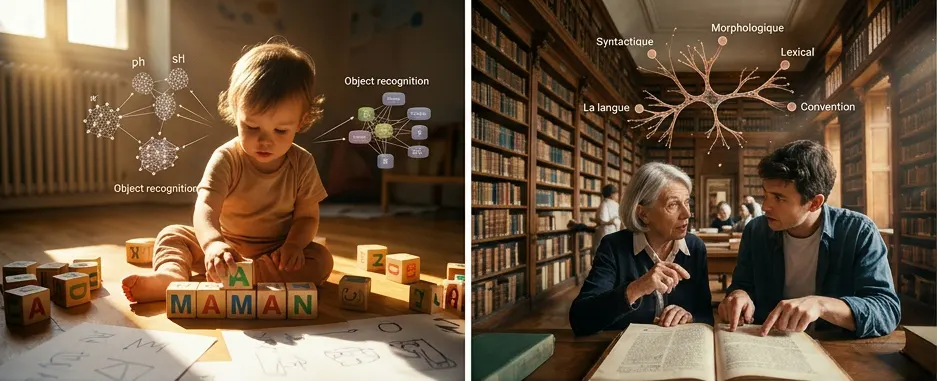
Observable Linguistic Competence
A model can demonstrate linguistic competence by producing a correct paraphrase, explaining an expression or identifying a contradiction.
These results are observable and can be measured using appropriate protocols.
However, success on a task does not automatically reveal all the mechanisms that made it possible. Several different systems may achieve similar results through distinct strategies.
Evaluation must therefore examine performance across sufficiently varied sets of tasks and identify the conditions under which it deteriorates.
Understanding Grounded in the World
Human beings learn language through interaction with a physical and social environment. Words refer to perceived objects, performed actions, sensations and experienced situations.
A model trained primarily on text learns relationships from linguistic representations. It can acquire considerable information about the world, but that information is mediated by its data and architecture.
Multimodal models can also process images, sound, video or other forms of data. They therefore have access to more diverse sources of information, without this guaranteeing an exhaustive, accurate or stable representation of the world.
Grounding concepts, causal understanding and the ability to connect words durably with experience remain important research questions.
The Problem of Truth
A text can be grammatically correct and convincing while still being false.
Generative models can produce inaccurate information, invent references, confuse people or present a hypothesis as an established fact. These errors are often referred to as “hallucinations” in the field of AI.
They do not necessarily result from an intention to deceive. They can occur when a system produces a plausible continuation without having sufficient information to guarantee its accuracy.
Writing quality is therefore not proof of factual reliability. Answers involving verifiable facts must be checked against appropriate sources, data or tools.
Consciousness and Intention
Producing first-person discourse does not demonstrate that a system possesses subjective experience. Similarly, the use of emotional terms does not prove the existence of a lived emotion.
Models can learn to produce descriptions of sensations, intentions and mental states. Whether certain artificial systems could develop a form of subjective experience is a separate scientific and philosophical debate.
It is therefore important to distinguish observable linguistic capabilities from conclusions about consciousness, intentionality or lived experience. The former can be tested directly; the latter require additional criteria that cannot be established by the fluency of a conversation alone.
13. Applications of Artificial Intelligence to Language
Natural language processing is not limited to conversational assistants. It is used in many digital services, from search engines and translation tools to transcription systems and document analysis.
Machine Translation
Translation systems make it possible to convert texts rapidly from one language into another. Modern models often take context into account more effectively than systems based on word-for-word correspondence.
They can help translate technical documents, web pages, professional correspondence and editorial content.
However, quality depends on the language pair, subject area, register, text length and available data. Languages that are underrepresented in digital corpora may yield weaker performance.
For legal, medical or administrative documents, specialist review may still be essential.
Summarisation and Document Synthesis
AI systems can condense a document, extract its main ideas, compare several texts or produce a thematic synthesis.
These capabilities make it easier to explore large volumes of information. They can help identify relevant material before a more thorough reading.
However, summarisation carries a risk of information loss. A nuance, methodological caveat or exception may disappear if the system favours an overly general formulation.
Summaries should therefore be assessed according to their fidelity to the original document, their coverage of essential points and their preservation of important distinctions.
Speech Recognition and Speech Synthesis
Automatic speech recognition converts an audio signal into text. It is used for transcription, subtitles, voice assistants and the indexing of recordings.
Speech synthesis, by contrast, produces artificial speech from text or an intermediate representation.
These technologies improve accessibility, documentation and interaction with digital services. However, they remain sensitive to accents, background noise, overlapping voices and pronunciation variations.
Voice processing also raises questions concerning consent, identity theft and the protection of biometric data.
Document Classification and Analysis
Language models can identify a document’s subject, extract entities, classify messages or detect certain categories of content.
These capabilities are useful for organising archives, processing administrative requests, monitoring information flows or facilitating searches across large document databases.
Performance depends on how categories are defined, the quality of the examples and the way errors are assessed.
Automated classification should not be regarded as inherently neutral. Training data and the criteria selected can introduce biases, particularly when results influence decisions concerning individuals.
Writing Assistance
Generative assistants can help structure a text, rephrase a passage, correct certain errors, adapt a register or produce several versions of a message.
They can speed up repetitive tasks and simplify document formatting.
Nevertheless, their use requires verification of the content, sources and suitability for the intended audience. A fluent text may contain factual errors or adopt an inappropriate tone.
The value of editorial work is not limited to producing sentences. It also encompasses topic selection, information prioritisation, investigation, fact-checking, accountability and judgement.
14. Programming Languages in Artificial Intelligence
Artificial intelligence models are not developed through natural language alone. Their design, training, deployment and evaluation depend on software infrastructures.
Python: A Core Language in the AI Ecosystem
Python plays an important role in artificial intelligence research and engineering. Its relatively accessible syntax, scientific ecosystem and libraries facilitate experimentation, data manipulation and the use of pretrained models.
Tools such as PyTorch and other specialised libraries make it possible to build neural networks, calculate gradients, train models and run inference.
Python is not, however, the only language in use. A project’s performance requirements and constraints may lead developers to combine several languages and environments.
C++ and High-Performance Components
C++ is used in many components that require precise resource management and high performance. It can be involved in computing libraries, inference engines and systems operating close to the hardware.
Computationally intensive operations are often optimised using specialised libraries and kernels executed on a processor or accelerator.
It is essential to distinguish between the language used to develop an application and the components that actually perform the computations. An interface written in an accessible language may rely on internal operations developed in languages closer to the hardware.
Julia and Scientific Computing Environments
Julia was designed, in particular, for scientific and numerical applications. It offers mechanisms intended to combine expressive syntax with performance suited to certain computationally intensive tasks.
Its usefulness depends on the field, the available ecosystem, team expertise and project requirements.
No programming language is a universal solution. The choice depends on performance needs, maintainability, interoperability, libraries and deployment constraints.
AI-Generated Code Must Remain Verifiable
Generative models can suggest code, explain errors and help convert a programme from one language to another.
However, they may produce non-existent functions, overlook security constraints or introduce defects that are difficult to detect.
Generated code must therefore be reviewed, tested and, where necessary, subjected to static analysis tools and validation procedures.
A model’s ability to produce plausible code offers a potential productivity gain. It does not remove the need to understand the operations being executed or verify their effects.
15. Can AI Systems Develop Their Own Language?
Research into artificial agents has explored whether multiple systems can learn to communicate through conventions that emerge during their interactions.
In some experimental environments, agents trained to accomplish a shared task can develop codes or communication protocols suited to their objectives. These conventions may differ from human languages and may not be directly interpretable without further analysis.
However, several distinct phenomena are often grouped under the expression “autonomous language”.
A Communication Protocol Is Not Necessarily a Human Language
Agents can exchange signals associated with actions or states. A system may learn that a particular sequence facilitates coordination in a given task.
This mechanism is closer to learning a functional protocol than to acquiring a natural language in its entirety.
Communications may be compact, specialised and effective within the training environment while remaining difficult for a human observer to interpret.
Their existence does not prove that agents possess communicative intentions comparable to those of humans or that they spontaneously develop an autonomous linguistic culture.
Why Do Conventions Emerge?
When several agents need to coordinate their actions, they may benefit from shared representations that reduce uncertainty or make problem-solving easier.
Learning can then favour signals that efficiently convey the information required to complete the task.
The structure of the protocol depends on the objectives, the environment, the architectures used and the training constraints. A system designed to communicate with humans will generally have different requirements from one whose exchanges are intended exclusively for other agents.
The Limitations of These Experiments
Results obtained in controlled environments should not automatically be generalised to systems deployed in the real world.
A protocol may work only for a particular task and lose its effectiveness when conditions change. It may also be difficult to audit if its conventions are not explicit.
For critical applications, interpretability, traceability and the ability to control exchanges between agents become important security considerations.
Implications for the Future of AI
Multi-agent systems can be designed to distribute tasks: searching for information, analysing data, planning an operation or checking a result.
Their coordination may rely on natural-language messages, structured formats or specialised protocols.
The choice of representation influences the system’s transparency and reliability. Natural language facilitates human inspection but can introduce ambiguity. Structured formats are often easier to validate automatically, but they require precise specifications.
The central question is therefore not simply whether AI systems can invent codes, but under what conditions such communications remain understandable, controllable and compatible with human objectives.
16. Language, Search Engines and Digital Visibility Optimisation
Language plays a central role in the indexing of web content and in the way automated systems interpret it.
Search engines must analyse texts, identify topics, understand certain relationships and match pages to search intentions. Conversational assistants may also use documents to answer questions, depending on how they access information.
Editorial optimisation is therefore not simply a matter of repeating keywords. It requires clear organisation of topics, consistent terminology and sufficiently precise information to meet readers’ needs.
Semantic Relevance Rather Than Mechanical Repetition
An article about language may cover linguistics, cognition, child development, semiotics, natural language processing and generative models.
These concepts are interconnected, giving the document its thematic coherence. A page that repeats a keyword without providing explanations may be less useful than a text that clearly answers the different questions associated with the subject.
A sound editorial strategy therefore prioritises precision, depth, structure and informational value.
Clear Titles and Sections
Headings structure content and help readers locate the information they are looking for. They also facilitate document analysis by making relationships between topics more visible.
Headings should accurately describe the content of their sections. A coherent hierarchy improves navigation and makes it possible to distinguish main themes from secondary discussions.
In a Markdown document intended for Hugo, level-two headings (`##`) can structure the main sections, while level-three headings (`###`) organise subsections.
This structure does not replace good writing, but it makes the content more accessible.
Structured Data and Context
Structured data make it possible to describe certain page elements using standardised formats. Depending on the type of content, they can specify the title, author, publication date, publishing organisation or other relevant properties.
They help automated systems interpret certain information, but do not in themselves guarantee a particular ranking or the display of a rich result.
Metadata must correspond to the content actually visible and to the page’s real characteristics. Inaccurate or misleading declarations can undermine information quality.
GEO and Visibility in AI-Generated Answers
The term Generative Engine Optimization (GEO) is used to describe practices intended to improve content visibility in environments where generative systems synthesise information or produce answers.
This field is still evolving. Methods vary according to the platforms, their document retrieval mechanisms, their models and their selection criteria.
The most robust editorial principles nevertheless remain familiar: verifiable information, identifiable sources, clear definitions, coherent structure, demonstrable expertise and updates when the subject requires them.
No method guarantees that an assistant will cite a page. Systems do not all consult the same corpora or necessarily use the same search mechanisms.
The priority should therefore remain the production of content that is useful to readers, rather than attempts to manipulate systems whose precise operation may vary.
Linguistic Quality as a Factor in Trust
Clear writing makes it easier to identify concepts, arguments and factual information. Imprecise wording, contradictions and unnecessary repetition make content more difficult to assess.
However, writing quality does not guarantee truthfulness. A text can be perfectly written and still contain errors. Reliability also depends on source verification, methodological transparency and the distinction between facts, hypotheses and interpretations.
For editorial websites specialising in artificial intelligence, this requirement is particularly important: speed of publication must not replace accuracy.
17. How Language Is Changing in the Age of Generative AI
The spread of language models is changing the conditions under which texts are produced and circulated. Tasks that previously required linguistic expertise or considerable writing time can now be partially automated.
This does not mean that all intellectual functions have become interchangeable. Instead, it redistributes roles between generation, verification, selection, interpretation and decision-making.
Automating Writing Tasks
Generative systems can produce drafts, adapt a text to different audiences, suggest headlines, summarise documents and correct certain formulations.
These capabilities can reduce the time required for repetitive operations. They can also make writing tools accessible to people with fewer linguistic or technical resources.
Nevertheless, the quality of the result depends on the instructions, the context provided, the available data and the ability to verify the final text.
Automation does not eliminate the need to define an editorial objective, select relevant information and take responsibility for published content.
The Risk of Stylistic Uniformity
Models learn patterns present in their training data. They can produce fluent, conventional texts, but may also reproduce common structures, predictable transitions and generic formulations.
If content is generated without substantial editorial work, this tendency can encourage a degree of uniformity in discourse.
Originality, however, does not depend on wording alone. It also stems from topic selection, investigation, source quality, analytical perspective, examples and the ability to establish new relationships between pieces of information.
AI can therefore support original work when it forms part of a process of research and verification. It can also produce repetitive texts when generation entirely replaces intellectual work.
Verification Becomes a Core Skill
As text production becomes faster, information verification becomes increasingly important.
Generated content may contain incorrect dates, non-existent references, distorted quotations or conclusions that go beyond the available evidence.
Verification involves checking sources, comparing versions, examining data and distinguishing established information from interpretation.
In journalism, scientific research and institutional communication, this function cannot be reduced to simple grammatical proofreading.
New Linguistic Skills
Effective use of AI requires the ability to formulate a request, provide context, specify an objective and evaluate a response.
Language proficiency thus becomes a key skill for interacting with digital systems. Users must be able to distinguish an ambiguous instruction from a precise one, identify an irrelevant answer and request justification or a source when necessary.
This skill is not about learning magic formulas. It rests on the ability to define a problem, organise information and verify the result obtained.
Editorial Responsibility
Content generated by a model remains subject to the responsibility of the people or organisations that publish it, who must assess its uses and consequences.
Responsibility includes checking facts, complying with applicable rights, protecting confidential information and avoiding misleading formulations.
Transparency about the use of AI may be relevant depending on the context, professional standards and audience expectations.
The issue is not merely who wrote the sentences, but who verified the information, who selected the angle and who is accountable for the publication.
18. Language, Power and the Construction of Social Reality
Language does more than describe the world. It also shapes how societies define problems, assign roles and organise debates.
Words can make certain aspects of a situation visible while leaving others in the shadows. They can direct attention, construct categories and influence how events are interpreted.
Naming Is a Form of Categorisation
A linguistic category brings different phenomena together under a common label. This process facilitates understanding, but it can also oversimplify the diversity of situations.
The terms used in the media, institutions and public debates help determine what appears normal, exceptional, threatening or desirable.
Discourse analysis examines these lexical choices, their effects and their relationship with social contexts.
This does not mean that words entirely determine behaviour. Interpretations also depend on experiences, institutions, interests and circumstances.
Political and Media Language
A public statement can inform, justify a decision, mobilise support or delegitimise an opponent. Language then acts as an instrument of coordination and influence.
Metaphors, contrasts, repetition and framing choices help shape the narrative surrounding an event.
Rigorous analysis requires distinguishing a discourse’s explicit content from its presuppositions, implicit meanings and potential effects on different audiences.
AI systems can help identify recurring lexical patterns or compare large corpora. They do not automatically replace investigation into context, possible intentions and the conditions under which discourse is produced.
Linguistic Biases in Models
Language models learn from data that reflect social practices and historical imbalances. As a result, they may reproduce stereotypical associations or treat certain formulations differently.
Biases can emerge in text generation, classification, translation or content evaluation.
Detecting them requires diverse tests, explicit criteria and an analysis of their consequences. A model that performs well on average may produce significantly poorer results for certain linguistic groups or situations.
Bias-reduction strategies do not simply involve removing a few words. They may require better data, appropriate evaluation, technical adjustments and continuous monitoring of how systems are used.
Underrepresented Languages
Digital resources are unevenly distributed across languages. Some have extensive corpora, electronic dictionaries and specialised tools, while others remain poorly represented in training data.
This inequality can result in weaker performance in translation, speech recognition or text generation.
The problem also affects regional varieties, minority languages and forms of communication that are scarcely represented in dominant corpora.
Developing more inclusive language tools requires high-quality resources, collaboration with the communities concerned and evaluations that take their actual usage into account.
19. Language as Collective Memory and Knowledge Infrastructure
Writing has profoundly transformed the transmission of knowledge. It makes it possible to preserve information beyond individual memory, compare documents and transmit knowledge between people separated by time and space.
Libraries, archives, scientific publications and databases form a cultural infrastructure that extends individual capabilities.
From Speech to Writing
Speech generally takes place within an interactive situation. Writing makes it possible to record an utterance and make it available for later consultation.
This relative stability facilitates transmission, but also introduces new requirements. A written text often needs to make explicit information that speakers might otherwise understand through shared context.
Writing also makes it possible to analyse language itself. Grammatical rules, definitions and arguments can be examined, corrected and compared.
Science and Conceptual Precision
Scientific disciplines develop specialised vocabularies to distinguish concepts and reduce certain ambiguities.
A precise definition makes it possible to determine what is included in a category and what is excluded. It facilitates the comparison of results and the reproduction of methods.
Terminology alone, however, does not guarantee scientific quality. A theory requires arguments, data and appropriate methods. Language is a tool for formulating and communicating ideas, not a substitute for evidence.
AI as a Tool for Accessing Archives
Natural language processing systems can facilitate searches across large collections, identify themes, connect documents and extract information.
These capabilities offer significant opportunities for libraries, research centres, media organisations and institutions with extensive archives.
They also entail risks. Automated extraction may omit a qualification, confuse entities or produce a summary that fails to respect the original documents.
A reliable document architecture must preserve links to sources, allow cited passages to be checked and distinguish extracted information from generated conclusions.
Digital Storage Is Not Human Memory
Computer systems can store texts, index documents and retrieve information. This capability should not automatically be equated with human autobiographical memory or lived recollection.
A model may have access to conversational context, a document database or a retrieval mechanism. These resources have distinct technical properties and may be subject to limitations involving retention, accuracy and access.
The distinction between storage, retrieval and lived recollection remains essential to an accurate description of artificial systems.
20. The Limits of Language and the Boundaries of Formalisation
Language can represent a wide range of realities, but every representation selects certain information and leaves other aspects aside.
A narrative does not reproduce an event in its entirety. A definition does not contain the full experience associated with a concept. A scientific description depends on the measurements, categories and assumptions adopted.
This limitation is not necessarily a defect. Representation works precisely because it organises and simplifies information.
The Difference Between a Description and Reality
A map represents a territory without being the territory itself. A mathematical formula describes certain relationships without reproducing every property of a physical phenomenon.
Similarly, a sentence can describe an experience without fully conveying the sensations, emotions or context in which it occurred.
Computer models also construct partial representations. Their effectiveness depends on how well these representations fit the intended task and the conditions of use.
The Limits of Explicit Rules
Formal rules are particularly useful when the conditions of a problem can be precisely defined.
They become more difficult to apply when data are incomplete, situations are numerous or decision criteria depend on a complex context.
Natural languages illustrate this difficulty: the same expression can have different meanings depending on the situation, and speakers regularly use incomplete formulations without disrupting communication.
Statistical learning methods make it possible to handle some of this variability, but introduce other problems, including dependence on data, uncertainty and difficulties of interpretation.
Formalisation as a Tool, Not a Universal Solution
Formalisation makes it possible to state assumptions explicitly, verify certain properties and make operations reproducible.
It does not guarantee that the original problem has been correctly defined. A system can apply a rule perfectly to an inadequate representation of a situation.
The quality of a solution therefore depends both on the rigour of the model and on the relevance of the assumptions adopted.
21. Evaluating Language Systems: What Counts as Evidence of Performance?
Advances in natural language processing are often presented through impressive demonstrations. Yet an isolated demonstration is not enough to characterise a system’s capabilities.
Evaluation must specify the task, the data, the success criteria and the conditions under which the results were obtained.
Metrics Suited to Each Task
Translation, speech recognition, summarisation, classification and text generation cannot all be evaluated in exactly the same way.
A metric useful for comparing translations may not reflect the quality of a factual answer. An automated evaluation of a summary may miss an important error if it focuses primarily on surface-level similarity.
Metrics should therefore be supplemented, where necessary, by human assessments and tests designed to detect relevant errors.
Testing Generalisation
A system must be evaluated on data that are not limited to those used for its training or fine-tuning.
Tests should examine its ability to handle unfamiliar formulations, unusual contexts and situations different from those encountered during development.
High performance on one set of questions does not guarantee equivalent performance in another domain.
Measuring Robustness
Language systems can be sensitive to small changes in wording. Altering the order of information, adding a negation or introducing a false premise can change a response.
Robustness tests examine the stability of results when conditions change.
They can also check whether a model recognises missing information, flags ambiguity or avoids giving a categorical answer when one is not justified.
Verifying Sources and Claims
When a system answers a factual question, it is important to distinguish the coherence of the response from its accuracy.
Verification procedures can draw on reference documents, databases, scientific publications or search tools.
In document-based applications, answers may be accompanied by citations that allow readers to locate relevant passages. However, the presence of a citation does not guarantee that the interpretation is correct: the cited passage must actually support the claim.
Evaluation in Real-World Conditions
Laboratory performance is not enough to predict every consequence of deployment.
Users may make unexpected requests, provide incorrect information or use a system in a context different from the one originally intended.
A comprehensive evaluation must therefore include error monitoring, ways to report problems, correction mechanisms and update procedures.
22. The Ethical and Social Implications of Artificial Language
Language technologies influence the circulation of information, professional practices and relationships between individuals and institutions.
Their deployment raises questions about transparency, confidentiality, fairness and accountability.
Data Protection
Texts submitted to an AI system may contain personal information, professional secrets or confidential data.
Organisations must examine processing conditions, retention policies, authorised access and the applicable contractual safeguards.
The necessary precautions depend on the service used and the legal context. In particular, sensitive data should not be submitted to a tool without checking the conditions under which they will be processed.
Disinformation at Scale
Generative tools can facilitate the production of misleading texts, fabricated testimonies and messages designed to manipulate public opinion.
The speed of generation can reduce the cost of certain disinformation operations, although actual dissemination also depends on platforms, networks and audience behaviour.
The response cannot rely exclusively on automated detectors. It requires verification mechanisms, traceability where possible, rigorous editorial practices and media literacy.
Copyright and Content Provenance
Model training, text reuse and content generation raise complex legal and economic questions.
Applicable rules depend, among other things, on the jurisdiction, the nature of the data, the contracts and the uses involved.
It is important to distinguish a piece of content’s provenance, its potential legal protection and the conditions under which it may be reproduced or transformed.
Organisations using AI in an editorial workflow must establish procedures suited to their obligations and professional practices.
Accessibility and Inclusion
Language technologies can facilitate communication for people facing linguistic barriers or certain disabilities.
Automatic transcription, speech synthesis, translation and conversational interfaces can improve access to information.
These benefits are not automatic. Tools must be evaluated across the languages, accents, communication modes and needs of the people concerned.
A system that works well for a majority group may have significant limitations for other users.
23. The Future of Language in the Age of Multimodal Systems
Artificial intelligence systems are no longer limited to text processing. Some models can combine language, images, audio, video and other forms of data.
This development changes the ways in which machines can receive information and respond to users.
Connecting Words and Images
Multimodal models can describe an image, answer visual questions or associate textual elements with graphical representations.
These capabilities make it possible to build interfaces in which a person can ask questions about a document, photograph or chart.
Reliability, however, depends on image quality, the task and the system’s ability to distinguish visible information from assumptions.
A generated description may seem plausible while attributing a detail to an image that is not actually present. Important information should therefore be verified whenever the stakes warrant it.
Speech as an Interface
Voice-based systems make it possible to interact without a keyboard. They can recognise a request, generate a spoken response and, in certain architectures, process additional acoustic cues.
This development facilitates mobile use and situations in which typing is impractical.
It also raises questions about consent, the confidentiality of recordings and recognition reliability in noisy environments.
Physical Context and Autonomous Systems
In robotics and interactive environments, language can be used to give instructions to a system that perceives its surroundings and performs actions.
A robot might receive an instruction such as “bring the object on the table”. To carry it out, it must connect the words to observed elements, identify the relevant object, plan a route and respect safety constraints.
The challenge goes beyond language generation. It involves perception, planning, environmental representation and the verification of consequences.
Language thus becomes an interface between human intentions and operations that can change the physical world.
Towards More Natural Interactions
Conversational interfaces can reduce some of the difficulties involved in using software. Instead of navigating menus, users can describe their objective directly.
This apparent simplicity nevertheless requires a reliable architecture. The system must identify missing information, request clarification when necessary and distinguish a descriptive request from an instruction authorising an action.
A natural interface should not conceal the complexity of the operations performed behind the scenes. The more a system can act on data or services, the more important permissions, traceability and confirmation mechanisms become.
24. Linguistic Skills to Develop in an AI-Augmented World
The widespread adoption of conversational assistants does not make language proficiency less important. Instead, it changes the skills needed to produce, interpret and verify information.
Knowing How to Formulate a Problem
An effective request specifies the expected result, the relevant context and the important constraints.
A vague instruction may lead to a general answer. A more clearly defined instruction often produces a more suitable result, although it does not guarantee accuracy.
Formulating a request is therefore a first step in solving a problem, not merely a stylistic exercise.
Knowing How to Read Critically
The ability to analyse a text remains essential, whether it was written by a human or generated by a machine.
Readers must identify the main claims, examine the evidence, distinguish facts from opinions and detect possible contradictions.
Fluent discourse should not distract attention from the quality of the arguments.
Knowing How to Verify
AI tools can accelerate information searches, but they do not replace authoritative sources.
Verification involves locating relevant documents, checking dates, comparing claims and examining the limitations of the available data.
This skill becomes particularly important when information concerns health, law, finance, security or decisions that affect other people.
Preserving the Ability to Exercise Judgement
Automation can facilitate certain tasks, but it can also encourage excessive confidence in generated results.
The quality of a decision depends on the ability to define relevant criteria, examine alternatives and recognise uncertainty.
AI can contribute to this process by suggesting analyses or avenues for further thought. Responsibility for the decision must remain clearly assigned in contexts where significant consequences are involved.
25. What Language Reveals About Intelligence
Language is often used as an indicator of intelligence because it makes certain abilities observable, including reasoning, categorisation, memory and communication.
Yet it is not an exhaustive measure of every form of intelligence.
Intelligence Is Not Limited to Verbal Fluency
Some abilities are expressed primarily through perception, motor coordination, spatial reasoning, visual creativity or practical problem-solving.
A person may experience difficulties with expression while possessing remarkable abilities in other domains. Conversely, strong verbal fluency does not guarantee sound reasoning or accurate knowledge.
Assessment must therefore take into account the diversity of tasks and abilities being studied.
Language Models and Cognitive Performance
Generative models can succeed at tasks involving explanations, comparisons, symbolic reasoning or the resolution of problems expressed in natural language.
These performances warrant serious empirical analysis. However, they should neither be dismissed on principle nor automatically equated with every dimension of human intelligence.
Results depend on the tasks, data, tools, evaluation methods and conditions of use.
A system may perform well on a linguistic task while failing at another that requires verification, sustained interaction or precise knowledge of the real-world context.
Intelligence as a Set of Capabilities
Intelligence can be studied through different functions: learning, adaptation, problem-solving, representation, planning, communication and decision-making.
Language contributes to several of these functions, but does not encompass them all.
The study of artificial systems offers an opportunity to distinguish observable capabilities from the mechanisms that produce them more clearly. It also shows that comparable performance can emerge from different architectures.
The scientific question is therefore not merely whether a machine speaks like a human, but which tasks it succeeds at, how it achieves them, under what conditions it fails and what these results genuinely allow us to conclude.
Conclusion: Language as an Interface Between Human Thought, Culture and Artificial Intelligence
Language is a faculty of representation, a system of signs, a social practice and an instrument of action. It makes it possible to transform experience into concepts, share knowledge and build forms of cooperation that extend beyond the limits of immediate perception.
The development of language in children shows that linguistic abilities emerge gradually from biological capacities, social interactions and learning. The relationship between language and thought reveals a profound connection between words, representations and cognitive processes, without implying that all mental activity can be reduced to verbal formulation.
The study of linguistic structures reveals several complementary levels: sounds, word forms, syntax, semantics, pragmatics and discourse organisation. These dimensions help explain why language is both productive and ambiguous, sufficiently regular to be analysed yet flexible enough to adapt to unforeseen situations.
Artificial intelligence is introducing a significant transformation into this landscape. Language models can process vast quantities of text, generate coherent responses and support many intellectual activities. Multimodal systems broaden these possibilities further by combining language with images, speech and other forms of data.
These capabilities must be evaluated precisely. Producing a convincing text does not guarantee its truthfulness, and succeeding at a linguistic task does not, by itself, demonstrate human-like understanding, intention or consciousness. Models possess genuine capabilities, but these must be described in terms of observable results and clearly identified limitations.
The challenge in the coming years will therefore not simply be to produce machines that speak more naturally. It will also be to build systems that use information more reliably, make their outputs verifiable, respect the constraints of their applications and integrate responsibly into human activities.
From this perspective, language emerges as a meeting point between biology, cognition, culture, computing and society. Studying it helps us better understand human capabilities, analyse new forms of artificial intelligence and define the conditions under which language technologies can genuinely contribute to knowledge.
Glossary: Essential Concepts in Language and AI
- Language: The ability to use organised signs to represent information, construct meaning and communicate.
- Natural language: A shared system of signs, vocabulary, rules and conventions used by a community.
- Speech: The concrete realisation of language in an act of communication, particularly through the voice.
- Symbolic function: The ability to represent an object, situation or idea through a sign or symbol.
- Linguistic sign: A conventional association between a form and a meaningful content.
- Linguistics: The discipline that studies languages, their structures, uses and evolution.
- Phonetics: The study of the physical and articulatory properties of speech sounds.
- Phonology: The study of how sounds are organised within a language.
- Morphology: The study of word structure and the units that make up words.
- Syntax: The study of the rules governing the arrangement of words and word groups in sentences.
- Semantics: The study of the meaning of words, expressions and sentences.
- Pragmatics: The study of the meaning of utterances in their context of use.
- Formal language: A system of sequences defined by an alphabet and explicit rules.
- Formal grammar: A set of rules used to describe or generate linguistic structures.
- NLP: Natural language processing, a field of computing concerned with analysing and generating human languages.
- LLM: A large language model trained on extensive datasets to process and generate text.
- Token: A segmentation unit used by a language model to represent a text sequence.
- Transformer: A neural network architecture that uses mechanisms such as attention to process sequences.
- Deep learning: A family of methods that use neural networks containing multiple computational layers.
- Multimodal model: A system capable of processing or combining several types of data, such as text, images and audio.
- Hallucination: The production by a generative system of inaccurate or insufficiently supported information presented as plausible.
- GEO: A set of practices intended to improve content visibility in generative search and answer environments.
- Semiotics: The study of signs, their meanings and their uses.
- Metalanguage: A language used to describe, analyse or formalise another language.
- Inner speech: A form of mental verbalisation that can contribute to planning, self-regulation and reasoning.
Bibliographical and Scientific References
The following references provide starting points for exploring the main dimensions of language. They do not replace a specialised bibliography for each research question.
- Ferdinand de Saussure, Course in General Linguistics: foundations of structural linguistics and analysis of the linguistic sign.
- Henri Wallon, From Action to Thought (1942): the role of activity, representation and symbolic function in psychological development.
- Jean Piaget, works on cognitive development: the progressive construction of thinking processes in children.
- Lev Vygotsky, Thought and Language: relationships between language, social interaction and the development of psychological functions.
- Noam Chomsky, works on formal grammars and the language faculty: the formalisation of syntactic structures and the study of linguistic creativity.
- Charles W. Morris, works on semiotics: distinctions between syntax, semantics and pragmatics.
- Alan Turing, “Computing Machinery and Intelligence” (1950): a foundational discussion of the criteria for studying intelligent machine behaviour.
- Ashish Vaswani and co-authors, “Attention Is All You Need” (2017): presentation of the Transformer architecture.
- Jacob Devlin and co-authors, “BERT: Pre-training of Deep Bidirectional Transformers for Language Understanding” (2018): development of a contextual pretraining approach for natural language processing.
- Tom B. Brown and co-authors, “Language Models are Few-Shot Learners” (2020): a study of the ability of large language models to perform tasks using examples provided in context.
Contemporary language research requires theoretical approaches, empirical observations and computational evaluations to be brought together. This interplay between linguistic structures, cognitive mechanisms and the capabilities of artificial systems makes it possible to understand current transformations without reducing language to a mere collection of words or artificial intelligence to a superficial imitation of human conversation.
Cet article est rédigé par Blaise Grenier, Journaliste reporter d'images et auteur. Découvrir le parcours de l'auteur et la charte éditoriale »